

While my doctor or nurse is an expert on health and medicine, I am an expert on my own body and how I feel.
This guide was created with survivors for survivors to help others understand common challenges and connect with tools and support that can meet our needs.
To start, here is a video which shares simple ways for survivors to speak up for their needs, ask questions, and understand what safe, respectful care should look like during medical visits.
Every survivor’s experience is different and unfortunately, some survivors have had experiences in health care where we felt dismissed, unheard, or unsupported. Click here to read more from survivors in their own words.
It is important to remember, that options are available. Keep scrolling to find strategies to help us prepare for, navigate, and care for ourselves before, during, and after health care appointments.
We have options!
Strategies for preparing for a medical visit:
- Pack a “go-bag” ahead of time with items I may need at an appointment or emergency hospital visit: snacks, a water bottle, medications that I may need, medical marijuana card, etc.
- Write down specific health questions ahead of time (A site like AHRQ question builder can help!)
- Ask a trusted person to come with me and speak up for me if I need help.
- Look up doctors or clinics ahead of time to find places that may treat me better.
- Make a card with important health information (like past surgeries, medicines, or an emergency contact).
- Learn about what it might look like if your doctos does a screening for intimate partner violence, here.
- Make a card that says I am a trauma survivor and share it with medical staff if I want them to know my needs. (You can download a sample, here and your own printable copy, here.)
Strategies for taking care of myself during a medical visit:
- Making sure to eat and drink enough water.
- Taking medications as prescribed (the way the doctor told me to).
- Asking a trusted person to take notes for me or advocate for me during the visit.
- Asking for the accommodations that I need.
- Asking for a patient advocate that can be provided by the agency
- Practicing deep breathing tactics, tapping, or other practices that make me feel grounded
- Ensuring that I understand the next steps and any referrals provided.
- Scheduling a follow-up appointment, if needed, to discuss progress or further concerns
If I want to talk to my doctor about my abusive relationship, I have options, here.
Strategies for taking care of myself after a medical visit:
- Creating a plan for how I can take care of myself after my appointment or hospital visit.
- Scheduling in extra time after my appointment to relax and decompress.
- Making sure I have someone with me following the visit if I need support.
- Doing yoga, exercise, or anything else that makes my body feel good following the visit.
We have rights!
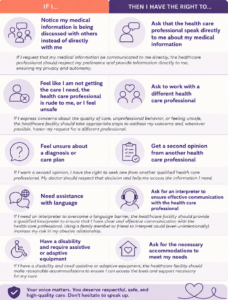
*Download your copy of the above chart, here. Learn more about your rights here, with the Patient Bill of Rights and here, with the Maryland Patient’s Bill of Rights Law.
*This document was co-created with the Maryland Health Care Coalition Against Domestic Violence, Physician and Health Disparities Researcher Dr. S. Michelle Ogunwole, and survivors of intimate partner violence.